
Struggling with Dark Under-Eye Circles? Why Is Vitamin K Your Overlooked Skincare Savior?
What Is Vitamin K, and How Does It Benefit Under-Eye Skin?
Discovered in 1929, Vitamin K is a group of fat-soluble compounds that play a critical role in circulatory health, particularly in aiding the liver’s production of blood-clotting proteins. While its internal health benefits have long been recognized, recent research has unlocked its potential for topical skincare—especially around the delicate eye area.
The eye area’s thin, fragile skin makes it prone to visible blood vessels, micro-tears, and pigment buildup—three key contributors to dark circles. Vitamin K addresses these issues through multiple mechanisms:
Strengthens blood vessels: It enhances the elasticity of capillary walls, reducing their likelihood of rupturing and leaking blood. This minimizes the appearance of vascular dark circles, which manifest as blue or purple hues.
Reduces melanin formation: Studies show Vitamin K inhibits melanin production, helping fade pigmented dark circles caused by sun exposure or inflammation.
Boosts wound healing: Its anti-inflammatory properties and ability to promote re-epithelialization speed up the repair of micro-damage to the under-eye area.
Blocks collagen calcification: By preventing calcium deposits in collagen fibers, Vitamin K maintains skin firmness and reduces fine lines that can accentuate dark circles.
There are two primary forms of Vitamin K used in skincare: Vitamin K1 (phytonadione), derived from leafy greens and most common in topical products, and Vitamin K2 (menaquinone), a fermented form gaining traction for its advanced skin benefits, including mitochondrial support.
Common Pitfalls of Dark Circle Products (and How Vitamin K Solves Them)
Most over-the-counter dark circle products fail to deliver results because they target only surface-level issues, ignore formulation flaws, or lack Scientific backing. Here are the top pain points—and how Vitamin K-based products overcome them:
Pitfall 1: One-Size-Fits-All Formulations
Dark circles fall into three categories: vascular (blue/purple), pigmented (brown), and structural (due to sagging or hollowness). Many products only target one type, leaving users disappointed. Vitamin K addresses both vascular and pigmented dark circles—two of the most common types—making it a versatile solution. A 2024 study published in Taylor & Francis Online found that a Vitamin K-infused hydrogel inhibited melanin formation by 31.76% and reduced L-dopa auto-oxidation (a key step in melanin production) by 94.80%, outperforming free Vitamin K.
Pitfall 2: Poor Ingredient Delivery
The eye area’s thin skin is difficult to penetrate, and many Vitamin K products use unstable formulations that degrade before reaching the dermis. This is why conventional creams often show no results. The solution lies in advanced delivery systems, such as liposomes and hydrogels. Liposomal Vitamin K, for example, uses a phospholipid membrane that fuses with the skin barrier, delivering stabilized Vitamin K deep into the dermis with minimal irritation. The same Taylor & Francis study noted that Vitamin K hydrogels enhanced percutaneous transport, ensuring the ingredient reaches the layers where it’s most effective.
Pitfall 3: Insufficient Concentration
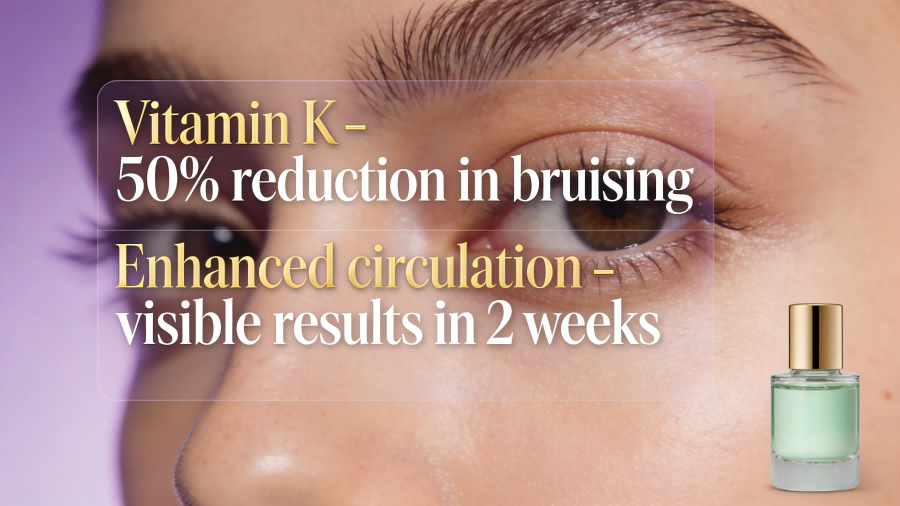
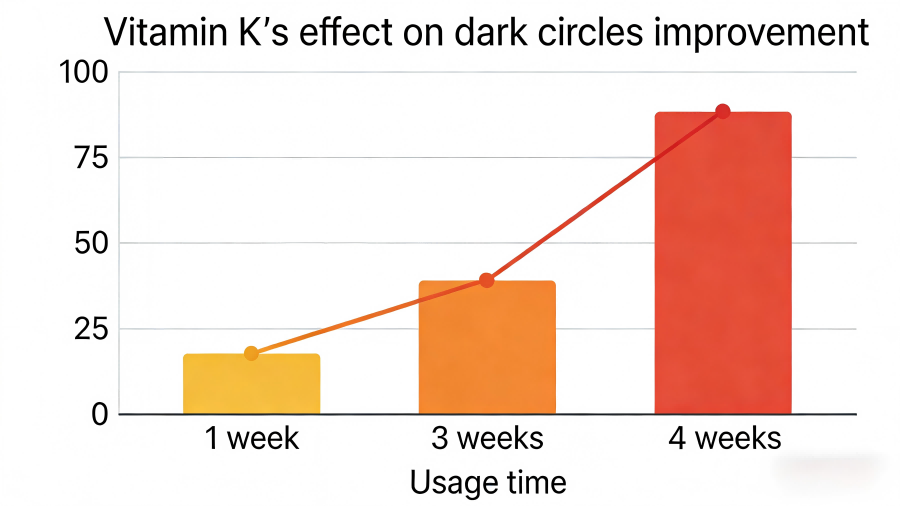
Many products add trace amounts of Vitamin K as a “marketing ingredient” without enough to deliver results. Research shows optimal concentrations vary by form: 0.05% Vitamin K2 (MK-7) has been proven to improve under-eye appearance in 2–4 weeks, while 1% Vitamin K1 is effective for wound healing and discoloration.
Pitfall 4: Irritation and Sensitivity
The eye area is highly sensitive, and harsh ingredients in dark circle products can cause redness or dryness, worsening discoloration. Vitamin K is naturally gentle—even suitable for post-procedural skin.
Vitamin K in Cosmetics: Applications and Product Advantages
Primary Applications
- Eye creams/serums: The most popular use case, targeting dark circles, puffiness, and fine lines. Formulations often pair Vitamin K with caffeine (to reduce puffiness) or hyaluronic acid (for hydration).
- Post-procedural products: Used to speed healing and reduce redness after laser treatments, electrocautery, or chemical peels.
- Redness-relief products: Addresses rosacea, spider veins, and post-inflammatory redness by strengthening blood vessels.
- Anti-aging creams: Prevents collagen calcification and supports firmness, reducing the appearance of wrinkles.
Product Advantages
- Multi-functional: Targets dark circles, redness, fine lines, and wound healing—eliminating the need for multiple products.
- Gentle yet effective: Safe for sensitive skin and the eye area, with no harsh side effects.
- Compatible with other ingredients: Works well with retinol, vitamins C/E, caffeine, and hyaluronic acid to boost results.
- Science-backed: Supported by clinical trials, making it a credible alternative to unproven “miracle” ingredients.
- Stable with advanced formulations: Liposomal and hydrogel delivery systems preserve Vitamin K’s efficacy and improve penetration.
How to Choose and Use Vitamin K Products for Dark Circles
To maximize results, follow these guidelines when selecting and using Vitamin K products:
- Check the concentration:Look for 0.05–1% Vitamin K (K1 or K2). Avoid products with “Vitamin K” listed near the end of the ingredient list—these have insufficient amounts.
- Opt for advanced delivery systems:Choose liposomal, hydrogel, or encapsulated formulations to ensure deep penetration.
- Pair with complementary ingredients: Caffeine reduces puffiness, while vitamins C/E enhance antioxidant protection. Avoid mixing with harsh acids, which may irritate the eye area.
- Use consistently: Results take 2–8 weeks. Apply morning and night after cleansing, gently patting around the orbital bone (avoid direct contact with eyes).
- Combine with lifestyle habits:Skincare works best with internal support—prioritize 7–8 hours of sleep, limit salt intake (to reduce puffiness), and wear sunscreen (to prevent pigmented dark circles).
The Future of Vitamin K in Skincare
As consumers demand science-backed, multi-functional skincare, Vitamin K is poised to move from “overlooked” to “essential.” Ongoing research into Vitamin K2’s mitochondrial benefits—such as activating cell energy metabolism—could expand its use in anti-aging products beyond dark circles. With its proven safety, versatility, and clinical efficacy, Vitamin K is no longer a hidden gem—it’s the under-eye savior you’ve been searching for.
Name: Yuki
E-mail: sales02@nahanutri.com
WhatsApp:+8618066950297